 how-to
How to Choose a Mine Vehicle Maintenance Provider
Last Updated: October 26, 2026
Quick Summary
Choosing a mine vehicle maintenance provider requires prequalification assessment, capability verification, and a detailed service agreement with measurable commitments. Evaluate contractors on safety management systems, insurance, incident history, geographic reach, and documented response times rather than price alone.
- Prequalify providers by verifying licence, insurance, safety systems, training records, and incident history against a state regulator's public register.
- Tier your prequalification by site risk: Tier 1 for remote work requires full safety review; Tier 3 for low-risk work needs only licence and insurance checks.
- Define service levels in measurable terms: Priority 1 response within 4 hours, Priority 2 within 24 hours, Priority 3 within 5 business days.
- Request 90 days of historical response data from comparable sites and verify the provider's technician-to-site ratio can meet your SLA commitments.
- Include performance credits, insurance indemnity, data ownership, and transition assistance clauses in your service agreement to protect operations when issues arise.
Table of Contents
- Assess Mining Contractor Prequalification Requirements
- Evaluate Mine Vehicle Maintenance Capability and Fleet Coverage
- Review Mine Vehicle Breakdown Response Time Commitments
- Use a Mine Vehicle Maintenance Checklist for Comparative Assessment
- Clarify Mining Fleet Maintenance Service Agreement Terms
- Compare Total Cost of Ownership and Pricing Models
- Verify Safety Compliance and Parts Readiness
- Request References and Review Maintenance Data Reporting
- Frequently Asked Questions
Assess Mining Contractor Prequalification Requirements
Choosing the right mine vehicle maintenance provider starts before you request a quote. Prequalification separates contractors who can actually work on your site from those who merely say they can. Treat it as a scored exercise, not a paperwork collection.
Build a prequalification file, not a folder of PDFs
Ask every shortlisted provider for the same pack, in the same format, so you can compare like for like:
- Business identity and licensing, current Australian Business Number, business name registration, and any required state or territory trade contractor licence. Check the licence number against the state regulator's public register rather than accepting a scanned certificate.
- Insurance certificates of currency, public liability, workers' compensation (or a current exemption), and motor vehicle cover for mobile workshops. Confirm the policy is current on the award date, the limits are proportionate to your fleet risk, and diarise the renewal date.
- Safety management system evidence, not just a policy PDF. Ask for their field risk-assessment template, incident notification procedure, isolation and lock-out process, and a sample completed JSA from a comparable mine site.
- Training and induction records, site induction cards, relevant competencies (automotive mechanic trade qualification, air conditioning handling, fire suppression servicing), and current first-aid and driver training for the technicians who will actually attend your site.
Verify, don't assume
Mining procurement often accepts certificates at face value. Close the loop:
- Check the licence on the state regulator's public register.
- Call the insurer named on the certificate of currency to confirm the policy is active and the limits match what is stated.
- Ask for the site induction record for each named technician, not just the company.
- Request two referees who have used the provider on a site with comparable safety systems and ask specifically about incident reporting behaviour and hazard close-out.
Match the prequalification to your site's risk profile
Not every contractor needs the same depth of review. Tier your prequalification:
- Tier 1, field and remote work: full safety management system review, incident history, remote-site emergency response plan, and evidence of solo-work procedures.
- Tier 2, on-site workshop work: full insurance and induction verification, sample JSAs, and supervisor references.
- Tier 3, off-site or low-risk work: licence, insurance, and trade qualification checks.
This lets you move quickly on low-risk work without weakening controls where a maintenance failure can become a safety event.
Red flags worth walking away from
- Certificates of currency that are expired or about to expire with no renewal evidence.
- A safety system that exists only as a generic policy document with no site-specific risk assessments.
- Reluctance to name the individual technicians who will attend your site.
- No verifiable incident history, or a history that shows repeat serious incidents without evidence of corrective action.
Prequalification is not a gate you pass once. Set a review cycle, annually, or whenever insurance, licensing, or ownership changes, and re-verify the critical items.
Evaluate Mine Vehicle Maintenance Capability and Fleet Coverage
A mine vehicle maintenance provider must have both the mechanical expertise and the geographic reach to support your fleet across multiple sites.
Light vehicle specialisation and site-ready credentials
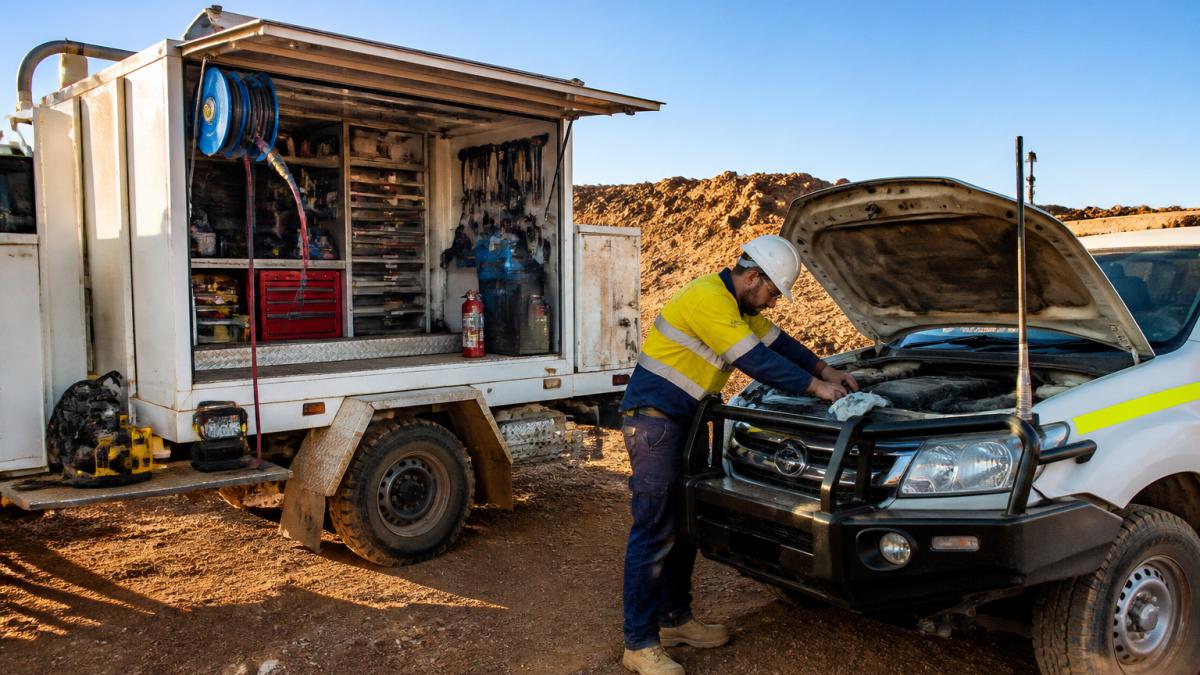
Light vehicles in mining face extreme demands. Your provider should offer specialised light vehicle mining services tailored to your fleet's specific needs.
Ask about their service history: how many light vehicle maintenance jobs in the past 12 months, and what breakdowns they've handled.
Site-ready credentials matter too: fire suppression compliance, air conditioning performance in extreme heat, and work that meets mine safety protocols.
Geographic reach and multi-site response capacity
If your fleet spans multiple mine sites, your provider's response capacity is critical.
Ask directly: "How many sites do you service, and what's your typical response time to each?" Too many sites and response times suffer; too few and they may lack experience.
Also check their equipment. Review the mine site compliance fit-outs and mobile support capabilities that demonstrate the provider's operational readiness.
Review Mine Vehicle Breakdown Response Time Commitments
Downtime is expensive in mining: a single breakdown can delay operations, disrupt crew schedules, and create safety gaps.
Your mine vehicle maintenance provider should commit to specific response times in writing. Reject vague promises and insist on documented service levels.
Response commitments should vary by severity: a safety- or production-critical breakdown deserves faster response than routine maintenance.
Use a Mine Vehicle Maintenance Checklist for Comparative Assessment
A checklist ensures each provider is evaluated against the same criteria.
Service scope and equipment coverage
List the services you need: mechanical repairs, air conditioning servicing, and fire suppression checks.
Rate each provider on full-scope delivery versus needing specialists. One provider covering everything reduces coordination.
Compliance documentation and safety protocols
Mining demands detailed compliance records. Your provider should document every service: what was done, when, by whom, and vehicle condition before and after.
Ask whether they provide digital records you can load into your maintenance management system and flag safety issues.
Clarify Mining Fleet Maintenance Service Agreement Terms
A service agreement makes a provider's promises enforceable. What matters is whether obligations are measurable, attributable, and verifiable at your site.
Define service levels in numbers, not adjectives
"Prompt response" is not a service level. Push for commitments that can be measured and reported:
- Notification-to-attendance time, the maximum hours from your call to a technician arriving at the nominated site gate, split by priority. For example: Priority 1 (safety-critical or production-stopping) within 4 hours; Priority 2 (vehicle off-road but not production-critical) within 24 hours; Priority 3 (planned or routine) scheduled within 5 business days.
- Repair turnaround time, the target time from attendance to vehicle returned to service, with a separate target for jobs requiring parts not held in stock.
- Reporting turnaround, how many hours after job completion you receive the service report and compliance documentation.
- Escalation path, named roles and contact numbers for after-hours escalation, and the maximum time before an unresolved Priority 1 job is escalated to a supervisor or director.
Verify the provider can actually meet the SLA at your site
A response-time commitment is only credible with logistics behind it. Before signing:
- Ask for their site coverage map, which depots or mobile units support your region, and the realistic travel time from each to your site gate.
- Ask for their current site count and technician-to-site ratio, a provider stretched across too many sites will miss Priority 1 targets during peak periods.
- Ask what happens when their nearest technician is already committed, is there a backup unit, a subcontract arrangement, or a queuing process? Get the answer in the agreement.
- Request 90 days of historical response data from two comparable sites, if the provider will release it. Past performance is the best predictor of future SLA compliance.
Build reporting and KPI obligations into the agreement
A provider that does not report performance cannot be managed. Specify the reporting you require and its frequency:
- Availability, percentage of time each vehicle is available for operational use.
- Mean time to repair (MTTR), average elapsed time from breakdown notification to return to service.
- Repeat failure rate, the proportion of jobs that return within a defined window for the same fault.
- Preventive maintenance compliance, the percentage of scheduled services completed on or before the due date.
Agree the data format too: a monthly report you can load into your maintenance management system, plus a quarterly review of trends and corrective actions.
Price the agreement transparently
A service agreement should make the cost structure visible, not bury it in a rate card:
- Callout fee, fixed or variable, and whether it applies to scheduled work.
- Labour rate, standard, after-hours, and public holiday rates, stated separately.
- Travel charges, how travel time and distance to remote sites are billed, and whether there is a cap.
- Parts, whether parts are charged at cost, at cost plus a stated markup, or at a schedule of rates; and who bears the cost of freight to remote sites.
Include the clauses that protect you when things go wrong
- Performance credit or remedy, what happens if the provider misses Priority 1 response targets repeatedly. A service credit or a right to terminate for persistent underperformance gives the SLA teeth.
- Insurance and indemnity, confirmation that the provider's cover extends to work on your site and that you are named appropriately.
- Confidentiality and data ownership, your maintenance data and vehicle records remain yours and are returned at the end of the agreement.
- Transition assistance, a handover period if you change providers, including transfer of service history and open work orders.
Fair Work Ombudsman guidance on independent contractor arrangements is relevant if you are weighing whether to engage a contractor or employ maintenance staff directly, because the nature of the relationship affects your obligations under Australian workplace law.
Service level agreements should define measurable commitments across response times, repair turnaround, and reporting.
| Commitment | Definition | Example |
|---|---|---|
| Notification-to-attendance time | Maximum hours from call to technician arrival at site gate | Priority 1: 4 hours; Priority 2: 24 hours |
| Repair turnaround time | Target time from attendance to vehicle returned to service | Varies by job complexity and parts availability |
| Reporting turnaround | Hours after job completion to receive service report | Specified in agreement |
| Escalation path | Named roles and contact numbers for after-hours issues | Unresolved Priority 1 escalated to supervisor or director |
| Availability | Percentage of time each vehicle is operational | Tracked monthly |
| Mean time to repair (MTTR) | Average elapsed time from breakdown to return to service | Tracked and reported quarterly |
| Repeat failure rate | Proportion of jobs returning for same fault within defined window | Tracked monthly |
| Preventive maintenance compliance | Percentage of scheduled services completed on or before due date | Tracked monthly |
Compare Total Cost of Ownership and Pricing Models
Price isn't just the hourly rate. Total cost of ownership includes downtime, parts, and logistics.
Verify Safety Compliance and Parts Readiness
Safety compliance isn't optional in mining. Your provider's approach to safety documentation and parts availability directly affects your operational risk.
For safety compliance, ask to see examples of their service records. You can learn how to verify mine site technician certifications before engaging a maintenance provider.
Request References and Review Maintenance Data Reporting
Real references from other mining operations tell you more than marketing claims.
Choosing a mine vehicle maintenance provider requires more than just finding someone with a toolbox. When you're ready to discuss how we can support your light vehicle fleet with mobile mechanical, air conditioning, and fire suppression services built for Goldfields conditions, get in touch to explore your options.
Frequently Asked Questions
What qualifications should a mine vehicle maintenance provider have?
Ask for an ARC certified trader licence and evidence of experience with mine-spec vehicle requirements.
How do I check whether a mining maintenance contractor is site-ready?
Ask whether the provider has a fully equipped mobile workshop and mine-site experience.
What should a mining fleet maintenance service agreement include?
A mining fleet maintenance service agreement can specify the service scope (mechanical, air conditioning, fire suppression).
How quickly should a mine vehicle maintenance provider respond to breakdowns?
Response time depends on your site's remoteness and operational criticality. Confirm response-time commitments in writing before engaging a provider, and ask how they handle simultaneous breakdown requests across multiple sites.