 how-to
How to Verify Mine Site Technician Certifications
Table of Contents
- Why Verification Matters Before a Technician Steps on Site
- What a Mine Site Technician Must Hold
- How to Check Training Certificates Online
- High-Risk Work Licence Verification
- Mining Competency Assessment: Matching the Credential to the Role
- Mine Site Contractor Prequalification Checklist
- Expired, Suspended, Revoked or Restricted Certifications
- Consent, Privacy and Recordkeeping for Employer Checks
- Frequently Asked Questions
Last Updated: October 20, 2026
Why Verification Matters Before a Technician Steps on Site
A mine site is unforgiving to anyone who isn't properly ticketed.
Knowing how to verify mine site technician certifications is a core supervisor skill, not a paperwork chore.
Verification confirms that a technician's certificate is genuine, current, and covers the work they'll actually do on your site.
Most guides treat verification as a single checkbox. In practice, it's a chain, break one link and the whole credential falls apart.
What a Mine Site Technician Must Hold
A mine site technician needs three things before they start: the right qualification, the right competency evidence, and any licence the task legally requires. Miss one and they aren't site-ready, no matter how many years they've been turning spanners.
Qualifications, Competencies and Licence Classes
Start by separating the documents into three piles.
- Qualifications come from a registered training organisation (RTO) and carry a course code on the certificate.
- Competencies are the units of competency inside that qualification, listed on the record of results.
- Licences are separate. High-risk work needs a licence, and that licence has its own number and expiry.
A common mistake is accepting a qualification certificate and assuming it covers everything. The certificate shows the qualification was issued; the record of results shows which units were actually completed.
Ask for both. Then check the course code against the role.
How to Check Training Certificates Online
You can check a training certificate online in three steps: confirm the RTO is currently registered, look up the certificate through the issuing body, and match the record to the person in front of you.
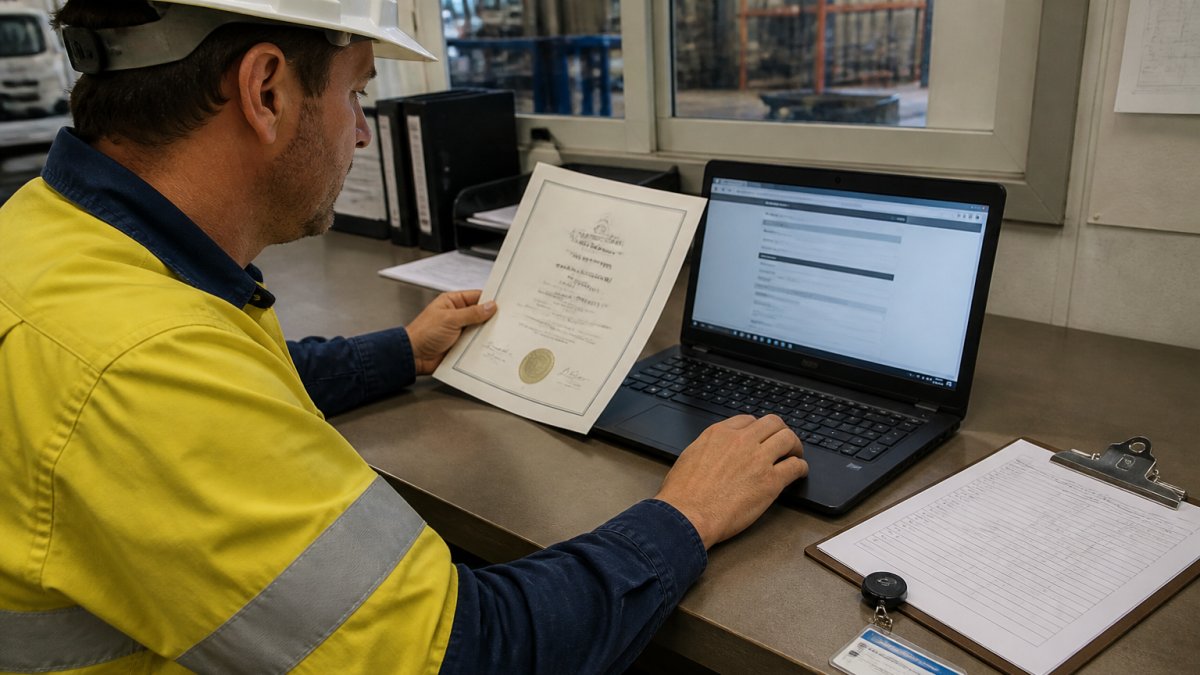
Authenticating a Credential With Its Issuing Body
The issuing body is your source of truth. Here's the order we use:
- Check the RTO is registered. Use the national training register to confirm the provider is current and can issue that course code. national training register Search by the RTO code printed on the certificate, not by the provider's trading name, trading names change, RTO codes do not. Confirm the scope of registration includes the course code and the current status is 'registered'.
- Find the issuer's own verification channel. Most RTOs publish a certificate verification page or a records team email. Use the contact details from the register entry, never the ones printed on the certificate. A fake certificate will list a fake phone number or a lookalike web address.
- Quote the certificate number and the person's full name. Ask the issuer to confirm the qualification code and title, the units completed on the record of results, the issue date, and whether the certificate is still valid. If the issuer offers a written verification letter or a portal screenshot, ask for it.
- Compare the response to the document. Names, dates, and course codes should match exactly. Watch for a middle name missing, a date that differs by a day, or a unit listed on the record that the RTO says was never delivered.
- Log the check. Record who you spoke to, the date, the method (portal, email, phone), and the outcome. Keep the written response with the credential file.
That last step matters: if a credential is challenged later, your log is the evidence that you did the work.
When the Issuer Has Closed or Been Deregistered
A common pattern is a genuine certificate from an RTO that has since closed or lost its registration. The certificate may still be legitimate, but the issuer can no longer confirm it. In that case:
- Check the national training register for the RTO's status history and any successor arrangement.
- Ask the technician for their USI transcript, which records nationally recognised training independent of the RTO.
- Treat the credential as unverified until you have a second source. Do not accept a statutory declaration alone for high-risk work.
What a Valid Response Looks Like
A clean verification response names the holder, the qualification code and title, the units completed, the issue date, and the issuing RTO, and it comes from a channel you found independently. If any of those five elements is missing, the check is incomplete, not failed, but not finished.
High-Risk Work Licence Verification
High-risk work licence verification means checking the licence number against the relevant work health and safety regulator, not just eyeballing the card.
Each state and territory runs its own regulator and public licence lookup, so first ask which regulator issued the licence. The card usually names it; if not, ask the holder which jurisdiction issued it and check that register.
Reading a Licence Record
A licence lookup typically returns more than a yes/no. Look for:
- Licence number and holder name, match both, not just the number.
- Licence class, high-risk work classes are coded (for example, the classes covering boom-type elevating work platforms, forklifts, dogging, rigging, and scaffolding). A licence for one class does not cover another.
- Conditions or restrictions, some licences carry conditions limiting the work allowed, such as supervision requirements or equipment restrictions.
- Status, current, expired, suspended, or cancelled.
Verify the licence number, the class of work, and the expiry date through the regulator's own lookup service. Safe Work Australia licensing guidance
Then check the class against the task. The card in the wallet may look right while the class is wrong for the work. A rigging licence does not authorise operating an elevating work platform, and a forklift licence does not cover a telehandler unless the class matches.
When the Lookup Returns Nothing
A blank result is a finding, not a dead end. Work through these in order:
- Re-check the number. Transposed digits and a missing letter are common.
- Confirm the jurisdiction. A licence issued in one state will not appear on another state's register.
- Ask for the physical card and a secondary identifier such as the holder's date of birth, which some lookups require.
- Contact the regulator directly using the contact details on its own website.
- Stand the technician down from licensed work until the status is confirmed. Unlicensed high-risk work is a safety and legal exposure you cannot absorb.
Licence Classes and Task Matching
Build a simple matrix for your site: task on one axis, required licence class on the other. Check it before the roster is locked to catch the most common failure, a genuine, current licence for the wrong class, before it reaches the pit.
Mining Competency Assessment: Matching the Credential to the Role
A mining competency assessment answers one question: can this person do the specific work on this specific site? The certificate gets them to the gate.
Match the credential to the role in four passes:
- Task match: do the units cover the actual tasks, including field work and in-service inspection?
- Site match: does the site require extra competencies, such as underground operations or underground searches?
- Equipment match: is the technician ticketed for the plant and systems they'll touch?
- Currency match: has the competency been used recently, or is it stale?
For mechanical and fire suppression work, currency is the question most supervisors forget.
This is where an all-in-one provider earns its keep: T U Mechanical Contracting keeps its technicians site-ready across mechanical, air conditioning, and fire suppression work, so the competency file stays current.
Mine Site Contractor Prequalification Checklist
A mine site contractor prequalification checklist is the document pack you request before a contractor can bid or mobilise. Build it once, use it every time, and stop chasing paperwork at the last minute.
Use this checklist for every contractor, including mobile providers:
- Company registration and insurance certificates, current
- Public liability and workers compensation cover, verified with the insurer
- Trade licences relevant to the work
- Fire suppression certification evidence, where relevant
The checklist filters out contractors who can't produce evidence and gives procurement a consistent standard.
Expired, Suspended, Revoked or Restricted Certifications
Expired, suspended, revoked, and restricted certifications are the four statuses that catch supervisors out. Each looks different and needs a different response.
| Status | What it means | What to do |
|---|---|---|
| Expired | The certificate or licence has passed its expiry date | Stand down until renewed and verified |
| Suspended | Temporarily invalid, often pending an investigation | Do not deploy; confirm with the regulator |
| Revoked | Permanently cancelled by the issuing body | Remove from site; do not re-engage without new evidence |
| Restricted | Valid, but with conditions on the work allowed | Deploy only within the stated conditions |
Treating an expired certificate as a minor admin issue is a mistake. An expired high-risk work licence means the person is not licensed, full stop.
The fix is a simple expiry register. Log every credential with its expiry date, and set a reminder well before it lapses.
Consent, Privacy and Recordkeeping for Employer Checks
Employer checks must run on consent and clean records.
Recordkeeping rules to follow:
- Store copies of verified documents, not originals
- Record the date, the person who checked, and the outcome
- Limit access to supervisors and compliance staff
- Set a retention period and delete records when it ends
- Handle personal information under the applicable privacy law OAIC privacy guidance for organisations
Australian privacy law sets rules for how you collect, use, store, and disclose personal information, and credential checks sit squarely inside them.
At T U Mechanical Contracting, every technician arrives fully inducted and ready to work, with documentation you can verify before we mobilise.
Verifying credentials takes effort, and that effort keeps a fleet safe and a site compliant.
Frequently Asked Questions
How can an employer verify a worker's training certificate?
Ask the worker for the certificate number and the issuing registered training organisation, then confirm the record directly with that provider or through the national training register. For licensed work, run a high-risk work licence verification through the relevant state or territory work health and safety regulator. Cross-check the name, unit of competency codes, issue date and expiry against the role requirements. Keep a dated record of each check. Never rely on a photocopy or a phone photo alone, because certificates can be altered and a copy does not prove current status.
What documents should a mine site technician provide before mobilisation?
A complete pack typically includes current qualifications and units of competency, any high-risk work licences, site-specific inductions, medical and fitness-for-work clearances, and insurance or trader licences where relevant. Add a mine site contractor prequalification checklist covering public liability cover, safety management documentation and plant registration. Ask for the certificate number and issuing body for every credential so you can verify rather than trust. Confirm each document is in the technician's own name and matches the role they will perform on site.
How do you check whether a high-risk work licence is valid?
Use the licence verification service run by the work health and safety regulator in the state or territory that issued it. You will need the licence number and the holder's name. The result shows the licence class, expiry date and whether it is current, suspended or cancelled. Check that the class matches the task, for example the right class for the plant being operated. Record the date of the check and the result. Re-verify before each mobilisation, because status can change between jobs.
How often should mine site training and competency records be checked?
Verify at prequalification, before every mobilisation and whenever a credential approaches expiry. Set a calendar reminder 60 to 90 days before each expiry date so refresher training can be booked without disrupting the roster. Re-check immediately if a technician moves to a new role, a new unit of competency or a different site with additional requirements. Spot-check a sample of records each quarter to confirm the system is working, and keep dated evidence of every verification for your audit trail.