 ultimate-guide
What Should Your Mine Site Safety Protocol Compliance Checklist Include?
Last Updated: October 25, 2026
Quick Summary
A mine site safety protocol compliance checklist is your documented system for verifying that every vehicle, piece of equipment, and operational process meets the legal and operational standards required to work safely on site. It prevents downtime, protects your team, and keeps your operation compliant by mapping every checklist item to the hazard it controls and the evidence that proves it has been done.
- Daily pre-start checks focus on tyres, brakes, lights, fluid levels, and communication equipment in five minutes.
- Weekly audits inspect suspension, brake pad wear, fluid condition, battery terminals, and emergency equipment functionality.
- Fire suppression systems require annual certification by a qualified technician and monthly visual inspections.
- A risk-based cadence matrix assigns assets to four tiers based on usage intensity, environment, and consequence of failure.
- Every corrective action requires evidence of closure and verification by a second person before sign-off.
Table of Contents
- Understanding Mine Site Safety Protocol Compliance Requirements
- Building Your Mine Vehicle Pre-Start Checklist
- Mine Site Fire Suppression Inspection Standards
- Daily and Weekly Mining Safety Inspection Template
- Mine Safety Inspection Frequency and Scheduling
- Hazard Identification and Risk Controls in Your Checklist
- Documenting Compliance and Managing Corrective Actions
- Implementing Your Site Safety Checklist and Getting Started
- Frequently Asked Questions
Understanding Mine Site Safety Protocol Compliance Requirements
Mining compliance spans vehicle mechanical readiness, fire suppression, ground control, traffic management, hazard identification, and fatigue management, each with its own inspection cadences, accountability roles, and evidence requirements.
The tightest operations map every checklist item to the hazard it controls and the evidence that proves it's been done, turning a box-tick into a genuine safety system.
Building Your Mine Vehicle Pre-Start Checklist
Your mine vehicle pre-start checklist focuses on equipment readiness that directly affects safe operation and prevents breakdowns that strand crews. Light vehicles in harsh conditions face accelerated wear, so pre-shift verification catches failures before they become incidents.

Mechanical readiness checks
Mechanical failures drive much of the unplanned downtime on remote sites.
Start with the five-minute basics: tyre condition and pressure (under-inflation accelerates wear and reduces control), lights and indicators (required for traffic management compliance), fluid levels, and brake responsiveness.
Check steering by turning the wheel lock-to-lock for smooth, responsive movement.
Document the date, time, vehicle ID, driver name, and any defects. A defective vehicle must not enter the mine site until repaired and re-checked.
Safety systems and equipment
Fire suppression systems, first-aid kits, and emergency communication equipment are non-negotiable, verify they're present, functional, and accessible.
Confirm the fire suppression unit is mounted securely, the pressure gauge reads in the green zone, and the nozzle is unobstructed.
Test radio or mobile connectivity, in remote areas, communication failure delays emergency response.
Work Health and Safety Act 2020 requirements for plant and equipment
Mine Site Fire Suppression Inspection Standards
Fire suppression systems on mine site vehicles must meet specific performance standards and inspection frequencies.
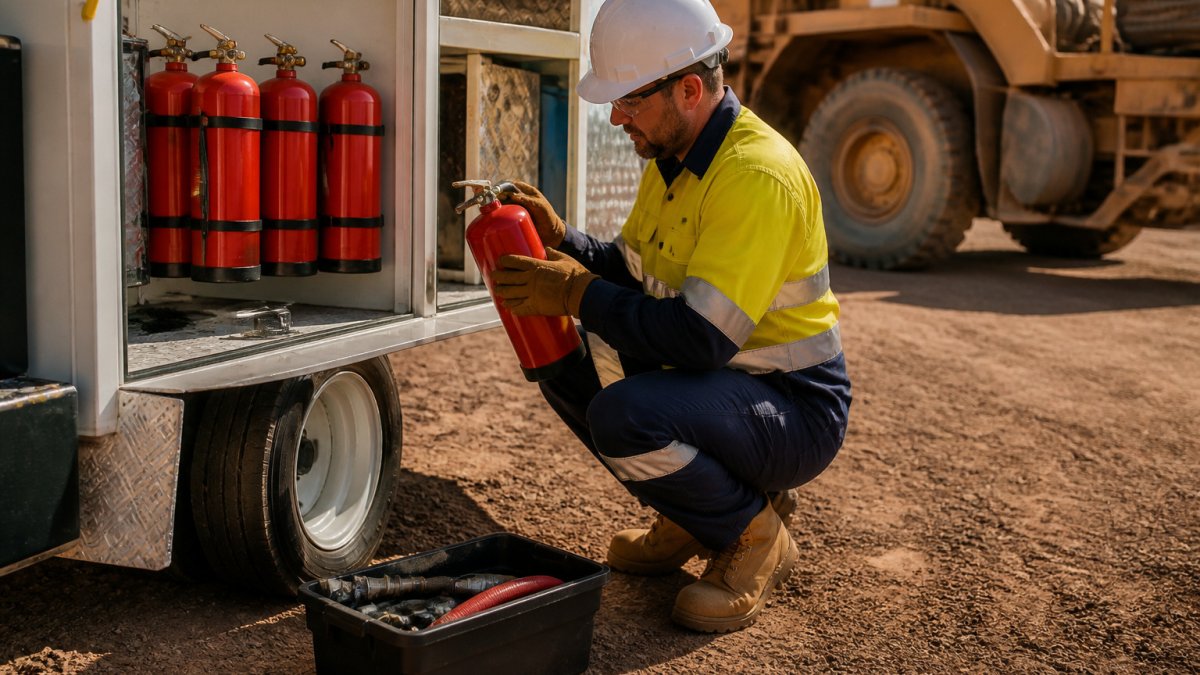
Units require annual certification by a qualified technician who pressure-tests the system, verifies the agent hasn't degraded, and confirms secure mounting.
Retain documentation of every inspection and certification on the vehicle or in fleet records.
You can access our light vehicle fire suppression services to ensure your fleet meets current standards and maintains current certification across all vehicles.
Daily and Weekly Mining Safety Inspection Template
A structured inspection template ensures consistency and completeness, catching emerging issues before they become failures while making responsibility and completion easy to track.
Daily inspection priorities
Daily inspections focus on systems most likely to degrade during operation: tyres, brakes, lights, fluid levels, and communication equipment. A five-minute morning walk-around catches slow leaks, punctures, or electrical issues before they escalate.
Assign one person per shift to complete and sign off the daily inspection. Record the date, time, vehicle, driver, inspector, any defects, and the corrective action and completion date.
Weekly audit focus areas
Weekly inspections go deeper: suspension condition, brake pad wear, fluid condition, battery terminals, wiper blades, and emergency equipment functionality. A weekly audit takes 15-20 minutes per vehicle and catches wear patterns daily checks miss.
Use a standardized form listing every item so nothing is overlooked, and assign the weekly inspection to a supervisor or maintenance technician authorised to pull a vehicle from service.
Mine Safety Inspection Frequency and Scheduling
Inspection frequency should be set by risk, not habit. A fixed calendar either over-inspects new plant or under-inspects ageing plant in harsh conditions. Use a risk-based cadence matrix that assigns each asset to a tier based on usage intensity, environment, and consequence of failure.
A risk-based cadence matrix
Most operations find four tiers workable. The tiers below are a starting structure, not a mandated standard, adjust the intervals to your site's risk assessment and the manufacturer's requirements.
| Tier | Typical asset profile | Daily pre-start | Weekly audit | Monthly deep inspection | Annual certification |
|---|---|---|---|---|---|
| A, Critical | Haul trucks, loaders, light vehicles on haul roads, any plant with fire suppression | Every shift | Every 7 days | Every 30 days | Fire suppression and safety equipment annually |
| B, High use | Service vehicles, crew transport, light vehicles on unsealed roads | Every shift | Every 7 days | Every 60 days | Annually |
| C, Moderate | Site utility vehicles, pool vehicles | Every shift | Every 14 days | Every 90 days | Annually |
| D, Low use | Standby plant, seasonal equipment | On each use | Every 30 days | Every 180 days | Annually before return to service |
Review tier assignment whenever an asset changes role, moves to a new pit or haul route, or records a repeat defect. A vehicle failing two consecutive weekly audits should be escalated one tier until it completes a clean inspection cycle.
Triggers that override the calendar
A schedule alone is not enough. Certain events should force an out-of-cycle inspection regardless of where the asset sits in its cadence:
- After any incident or near miss involving the vehicle or its operator.
- After a significant impact, hitting a berm, stockpile, or other plant, even if no damage is visible.
- After a defect is repaired, before the vehicle returns to service.
Scheduling mechanics that prevent drift
Weekly and monthly inspections get deferred when they depend on memory. Build the schedule into whatever system already drives shift planning:
- Fixed weekly slot. Assign weekly audits to a named day and shift (for example, Tuesday day shift) so they are predictable and cannot be quietly pushed.
- Monthly close-out. Schedule monthly deep inspections to complete before the last working day of the month, with a named supervisor accountable for sign-off.
- Annual recertification reminders. Set reminders 30 and 14 days before fire suppression and safety equipment certification expires. A lapsed certification is a compliance gap that auditors flag immediately, and it is entirely preventable with a diary reminder.
Recording the schedule as evidence
Document the cadence matrix and tier assignment for every asset in writing under version control. Auditors want to see the frequency was deliberately set against risk and followed. A one-page cadence matrix per asset class, signed off by the site WHS manager and reviewed annually, usually suffices.
Safe Work Australia guidance on inspection and maintenance of plant
Hazard Identification and Risk Controls in Your Checklist
Every item on your mine site safety protocol compliance checklist maps to a specific hazard. If you can't name the hazard, the control probably doesn't belong.
For each hazard, specify the control, inspection frequency, responsible person, evidence collected, and what happens if the control fails, turning the checklist into a documented risk management system auditors can verify.
Documenting Compliance and Managing Corrective Actions
Inspection records are your proof of compliance, but a folder of forms is not an evidence system. Auditors test whether each control has a named owner, a defined evidence artefact, a pass/fail criterion, and a verified closure trail when something fails.
Map every checklist item to evidence, owner, and criteria
Before worrying about software, build a control register. For every item on your mine site safety protocol compliance checklist, record five fields:
| Field | What it captures | Example |
|---|---|---|
| Control | The check being performed | Fire suppression pressure gauge in green zone |
| Hazard controlled | The failure mode it prevents | Vehicle fire escalating without suppression |
| Evidence | The artefact that proves the check happened | Dated photo of gauge plus signed daily form |
| Owner | The role accountable for the check | Shift supervisor |
| Pass/fail criterion | The objective test | Gauge needle within green zone; any reading below = fail |
If you can't fill in all five fields, the item isn't yet a control, it's an aspiration. Define the evidence and criteria, or remove it.
Corrective-action workflow
When a check fails, follow a defined path rather than relying on someone to chase it:
- Raise the action at the point of inspection. Record the defect, the vehicle or asset ID, the inspector, and the date and time. Attach a photo where the defect is visible.
- Assign an owner and a due date. Critical defects (brakes, steering, fire suppression, structural) are typically due within 24 hours and the asset is tagged out until closed. Major defects are typically due within 7 days. Minor defects are typically due within 30 days. These intervals are a common starting point, set yours against your risk assessment.
- Escalate automatically on overdue. If an action passes its due date, it should escalate to the next level of supervision without anyone having to notice. A simple rule, 24 hours overdue escalates to the maintenance supervisor, 72 hours to the site WHS manager, removes the reliance on memory.
- Verify closure, do not just accept it. Closure should require evidence: a re-inspection record, a repair invoice or job card, or a photo of the corrected condition. The person who raised the action should not be the only person who signs it off.
- Record the verification. The action is only closed when the verification evidence is attached and a second person has signed off.
Recordkeeping and audit readiness
Retention periods vary by jurisdiction and record type, so confirm the requirement for your site. As a baseline, most operations retain inspection and corrective-action records at least as long as their WHS regulator requires, and longer where the record supports a certification or statutory defence.
A practical evidence pack for an audit typically contains:
- The current control register (version-controlled, with a review date).
- The cadence matrix and tier assignments for each asset class.
- Completed inspection records for the audit period, filed by asset and date.
Digital systems make this easier, but a well-organised spreadsheet with consistent naming and a version-controlled register satisfies most auditors. The test is producing the pack within a working day, not the platform you use.
A note on the standard
AS/NZS 4801 has been superseded by ISO 45001 as the primary occupational health and safety management system standard, though some sites still reference AS/NZS 4801 in legacy documentation. Confirm which standard your site's management system is certified against before you map your checklist to it.
Australian Standards AS/NZS 4801 and ISO 45001 for occupational health and safety management systems
Implementing Your Site Safety Checklist and Getting Started
Start by mapping your current hazards: what can go wrong with your light vehicle fleet, and what controls prevent it?
Next, design your checklist template with fields for vehicle ID, date, time, inspector, each item, pass/fail status, and corrective action.
Assign responsibility explicitly: who does daily inspections, weekly audits, corrective actions, and record reviews, so nothing falls between the cracks. Learn about mine site compliance fit-outs and mobile support to help your team implement these responsibilities effectively.
You can review our best practices guide on fleet maintenance to align your checklist with industry standards and operational reality.
Run a two-week trial: use the checklist as designed, collect feedback, and adjust.
You can discuss your specific compliance needs with our team to ensure your checklist aligns with your site's operational requirements and regulatory obligations.
Frequently Asked Questions
What should a mine site safety protocol compliance checklist include?
Your mine site safety protocol compliance checklist must cover pre-shift vehicle inspections (brakes, steering, tyres, lights, fluid levels), ground control and slope stability assessments, haul road and traffic conditions, equipment and mobile plant readiness, fire suppression system certification, hazard identification and risk assessment findings, corrective action tracking, personal protective equipment availability, and worker consultation records. The checklist should map each item to your work health and safety obligations and include space for inspector sign-off and dates to demonstrate ongoing compliance.
How often should mine site safety inspections be carried out?
Pre-start inspections must occur daily before operations begin. Weekly audits should examine broader compliance areas such as ground stability, traffic management effectiveness, and environmental conditions. Monthly self-assessments should review hazard registers, corrective action closure, and worker consultation records. Quarterly audits verify the entire safety management system's effectiveness. Fire suppression systems require annual certification, though portable units may need more frequent checks depending on usage and site conditions. Adjust frequency based on equipment age, operating hours, and site risk profile.
What records should be kept to demonstrate mine safety compliance?
Maintain daily inspection records with inspector name, date, equipment or area inspected, and any defects found. Document all hazard identification sessions, risk assessments, and control measures implemented. Keep fire suppression certification certificates with service dates and technician details. Record corrective actions, including what was wrong, the fix applied, who completed it, and verification that the issue was resolved. Store worker consultation notes and any safety briefing attendance records. Digital recordkeeping systems simplify audit readiness and allow rapid retrieval of evidence during regulatory reviews or site audits.
What should be checked during a pre-start inspection of a mine vehicle?
Check brakes for responsiveness and fluid levels; steering for smooth operation and play; suspension for damage or leaks; tyres and wheels for tread depth, pressure, and damage; lights and indicators for function; fluid levels including oil, coolant, and brake fluid; windscreen wipers and visibility; seatbelts and restraints; fire suppression system presence and condition; and personal protective equipment storage. Verify the vehicle is clean and free of debris that could affect visibility or cause hazards. Document any defects and remove the vehicle from service until repairs are completed and signed off.
How should hazards and safety non-compliances be reported and corrected?
Establish a reporting system where workers, supervisors, and contractors can flag hazards immediately. Document each report with the hazard description, location, severity, and date identified. Assign a responsible person to investigate and implement corrective controls. Set a deadline for closure based on risk level: critical hazards within 24 hours, high-risk within one week, medium-risk within two weeks. Record the corrective action taken, who completed it, and verification that the hazard is resolved. Review all reports monthly to identify patterns and prevent recurrence. Digital tracking systems ensure accountability and provide audit evidence.
What fire suppression checks should be included in a mine vehicle inspection?
Verify the fire suppression unit is installed securely and accessible. Check the pressure gauge is in the green zone and within certification date. Inspect the nozzle and hose for damage, corrosion, or blockages. Confirm the safety pin is in place and the unit has not been discharged. Review the service tag to confirm annual certification by a qualified technician. Test accessibility by ensuring the unit can be quickly removed in an emergency. Document all checks on the vehicle's inspection record. Units found out of certification or pressure must be replaced immediately and the vehicle removed from service until compliant.
Who is responsible for maintaining safety protocols on a mine site?
Site Supervisors and Operations Managers hold primary accountability for overall safety management system implementation and compliance. Mine Operators and Equipment Operators are responsible for daily pre-start inspections and reporting hazards immediately. Maintenance Supervisors oversee corrective actions and equipment repairs. Safety Officers or Coordinators (if appointed) lead hazard identification, risk assessment, and worker consultation. All workers have a duty to follow protocols, report hazards, and use required controls. Contractors and visitors must be inducted and supervised. Senior management must ensure resources, training, and systems are in place. Clear role assignment in your safety management system prevents gaps and ensures accountability.
How does a mobile mechanical service ensure compliance documentation stays site-ready?
A specialist mobile provider maintains digital records of every service completed, including mechanical sign-offs, air-conditioning re-gas certificates, and fire suppression certifications. Each service visit generates a compliance document dated and tagged to the specific vehicle and site. Digital systems allow rapid retrieval of evidence for audits and regulatory reviews. The provider coordinates with your maintenance schedule to ensure inspections align with your site's inspection frequency requirements. By consolidating mechanical, air-conditioning, and fire suppression services with one certified technician, you eliminate coordination gaps and ensure every compliance requirement is documented and traceable.