 how-to
Heavy Duty Air Conditioning for Mining Fleets: A Practical Guide
Last Updated: October 30, 2026
Quick Summary
Heavy duty air conditioning for mining fleets is built for high pressure, constant vibration and heavy dust, unlike standard car units. Regular maintenance on mining fleets, scheduled before the hot season, prevents cabin cooling failures that take vehicles out of service and expose operators to heat stress.
- Heat stress slows decision-making and increases operator fatigue, so cabin climate affects safety.
- Heavy duty systems use heavier-gauge materials and fittings rated for vibration and higher pressures.
- Service the condenser and check airflow every 250 operating hours or weekly, whichever comes first.
- Treat repeat refrigerant top-ups as a leak to repair, not a recharge to repeat.
- Schedule a full pre-season service and performance test before the hot months begin.
Table of Contents
- Why Heavy Duty Air Conditioning Matters for Mining Fleets
- How Mining Vehicle Air Conditioning Systems Differ from Standard Units
- Mining Fleet Maintenance Checklist for Air Conditioning Systems
- Mining Vehicle Air Conditioning Maintenance Schedule and Pre-Season Service
- Air Conditioning Breakdown Prevention and Diagnostic Thresholds
- Mobile Air Conditioning Repairs for Mining Vehicles at Remote Sites
- Booking Your Fleet's Next Air Conditioning Inspection
- Frequently Asked Questions
Heavy duty air conditioning for mining fleets is no longer a comfort feature. In Western Australia's Goldfields, where summer temperatures regularly push past 40°C, a failed cooling system can take a light vehicle off the road and leave an operator exposed for the rest of the shift. This guide covers how mining fleets should approach heavy duty air conditioning, from system design through to maintenance and breakdown prevention.
Why Heavy Duty Air Conditioning Matters for Mining Fleets
Mining vehicles spend long hours in extreme heat, dust and vibration. A standard car air conditioner is not built for that work. Heavy duty air conditioning keeps the operator cabin cool, clean and workable, which protects both health and productivity.
Operator health, safety and productivity in extreme ambient heat
Heat stress slows decision-making and increases fatigue, so an overheated operator is more likely to make mistakes. A reliable cabin climate keeps attention on the task through the hottest part of the day.
Watch out: a cooling fault that is ignored during a hot spell often becomes a full breakdown within days.
How Mining Vehicle Air Conditioning Systems Differ from Standard Units
Mining vehicle systems are built to handle more load, more pressure and more punishment than a passenger car unit. Knowing the difference helps you ask the right questions when specifying or servicing a system.
High operating pressure, vibration resistance and heavy-gauge construction
Heavy duty systems use heavier-gauge materials and components rated for higher operating pressures, and are built to resist vibration, which loosens fittings and fatigues lines over time. Look for heavy-gauge construction, corrosion resistance and fittings designed for constant vibration.
Mining Fleet Maintenance Checklist for Air Conditioning Systems
A repeatable checklist turns maintenance from a reaction into a routine. The version below runs at defined intervals, with a measurement and a pass/fail decision at each step, so a technician can hand the completed sheet to a supervisor and a fleet manager can compare one machine against another. Shorten the intervals for high-dust haul routes, older machines or sites with known condenser fouling.
Interval structure
| Interval | Scope | Typical trigger |
|---|---|---|
| Every 250 operating hours or weekly (whichever comes first) | Visual and airflow checks, filter inspection, condenser clean | Routine service |
| Every 1,000 operating hours or quarterly | Full performance test, pressure check, leak inspection, electrical check | Scheduled service |
| Pre-season (before the hot months) | Full checklist plus a full-cooling function test and written record | Seasonal planning |
| Post-fault | Root-cause check before the vehicle returns to service | Any breakdown or repeat top-up |
Step 1, Condenser and airflow path
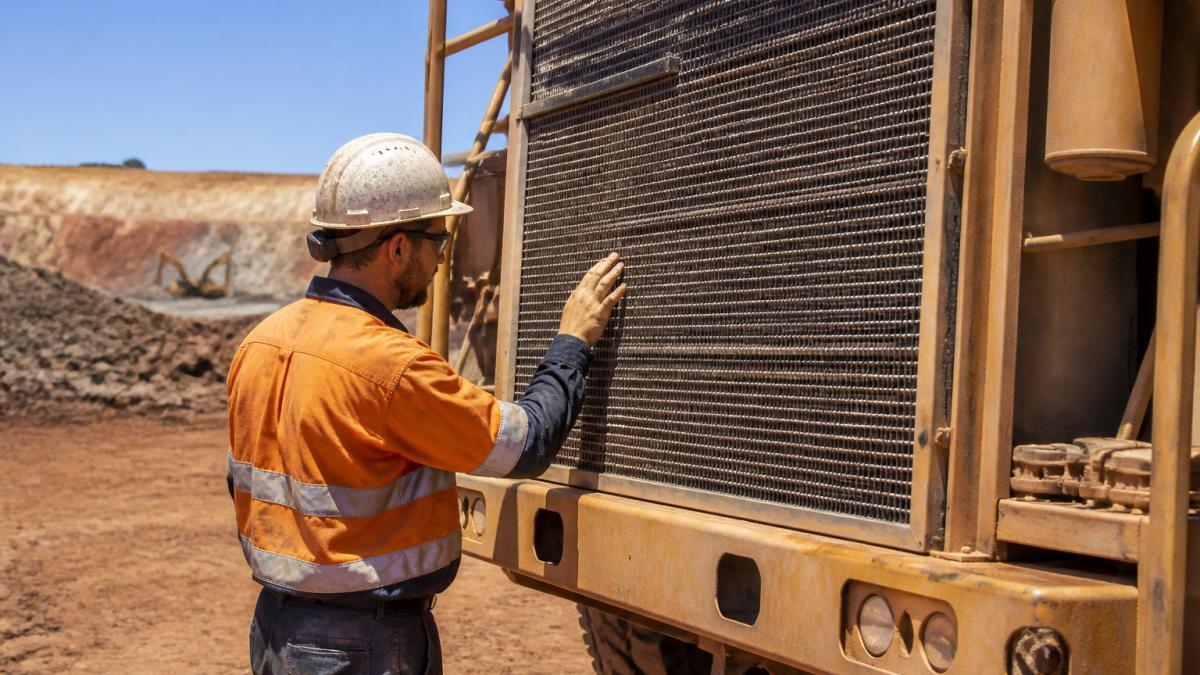
- Inspect the condenser fins for dust, mud and debris. Pass: light passes through the core when held to a light source. Fail: visible blockage across more than a small patch.
- Clean with low-pressure air or water, working from the inside out so debris is pushed out of the core rather than driven deeper. Keep the nozzle moving and avoid bending fins.
- Check the condenser fan clutch or electric fan operation and confirm the fan engages at the specified temperature.
Step 2, Cabin air filters and dust filtration
- Remove and inspect the cabin filter. Pass: light visible through the pleats. Fail: a caked or collapsed element, or a filter beyond the site's dust-based interval.
- Replace on a schedule matched to site dust levels rather than a fixed calendar. High-dust haul routes commonly need replacement at every 250-hour service; sealed-road service vehicles can often run longer.
- Check the filter housing seals and the recirculation door. A leaking seal lets dust bypass the element and coats the evaporator, which is far more expensive to clean than a filter change.
Step 3, Refrigerant charge, pressures and leak checks
- Record suction and discharge pressures at a defined ambient temperature and engine speed, and compare against the manufacturer's specification for that machine.
- Check the sight glass where fitted, and inspect hoses, fittings and the evaporator drain for oil staining, which commonly marks a leak.
- Log every refrigerant top-up against the vehicle. Pass: no top-up required between services. Fail: any repeat top-up, which points to a leak needing repair rather than another charge.
Step 4, Electrical and control checks
- Confirm the compressor clutch engages and disengages cleanly, and that the control panel holds the set point.
- Check the cabin temperature sensor and the blend door operation. A blend door stuck part-open will produce warm vents even when the refrigerant circuit is healthy.
- Inspect wiring and connectors for vibration damage, chafing and corrosion.
Step 5, Performance test and record
- Run the system at full cooling with the doors closed and record vent temperature, cabin temperature at the operator's seat, and the time taken to reach the set point.
- Record the result on the vehicle's history sheet. A single reading is a snapshot; a trend across services lets you plan a repair before a failure.
Escalation rules
- Repeat refrigerant loss, escalate to a leak repair, not another top-up.
- Vent temperature drifting upward across two services, book a diagnostic before the next hot spell.
- Condenser fouling returning within one service interval, review the site's dust exposure and consider a pre-cleaner or a shorter interval.
Equipment-specific differences
A mining fleet is not one equipment category, and the checklist should not be applied identically to every machine.
- Haul trucks, large cab volumes, long shifts and heavy dust exposure. Condenser and filter attention usually dominates; cab pull-down time is the key performance measure.
- Loaders and excavators, high vibration and frequent stop-start cycling. Watch fittings, hose chafing and compressor clutch operation.
- Drills, very high dust loads and tight engine bays. Filter and condenser intervals are typically the shortest in the fleet.
Parts and remote-site planning
Keep common filters, fittings, O-rings and a spare compressor clutch on hand where fleet size justifies it. For isolated sites, plan refrigerant handling and recovery equipment in advance, and confirm the technician's qualifications and the site's refrigerant handling requirements before the job, not on arrival.
Mining Vehicle Air Conditioning Maintenance Schedule and Pre-Season Service
Schedule maintenance before the hot season starts, not after the first failure. A pre-season service should cover the full checklist above, plus a function test of the cabin climate at full cooling. Many fleets also add a mid-season check, since dust loads build quickly during dry months.
Build the schedule around your operating hours and site conditions. Vehicles on high-dust haul routes need more frequent filter and condenser attention than those on sealed roads.
Air Conditioning Breakdown Prevention and Diagnostic Thresholds
Preventing breakdowns depends on watching the right numbers and knowing what to do when one moves. This section sets out how to measure cooling performance, how to interpret the results across different machines, and how to work from a symptom to a safe next check.
How to measure cooling performance
Measure under consistent conditions so results are comparable across services and across machines:
- Ambient temperature, record it at the start of the test. A vent temperature that looks acceptable at 25°C may be a failure at 42°C.
- Engine speed, test at a defined speed (for example, high idle) rather than at whatever the machine happens to be doing.
- Doors and windows, closed, with the cabin allowed to stabilise.
Interpreting the results
A single reading tells you little. The useful signal is the trend across services and the comparison between machines of the same type on the same site.
- Vent temperature drifting upward across two or more services, investigate before the next hot spell. Common causes are a slowly leaking system, a fouling condenser or a blend door not closing fully.
- Pull-down time lengthening, often airflow or condenser related rather than a refrigerant fault.
- Pressures outside the manufacturer's range at the specified ambient, a diagnostic trigger, not a reason to add refrigerant.
Because cab volume, glass area and insulation differ, compare like with like: a haul truck and a light service vehicle will not share the same pull-down time, and thresholds should be set per equipment type rather than fleet-wide.
Troubleshooting decision tree
Work from the symptom to the safest next check, and stop and escalate when a check falls outside the manufacturer's specification.
-
Weak airflow
- Check the cabin filter first. Replace if caked or collapsed.
- Check the evaporator for dust coating. Clean if fouled.
- Check the blower fan and its resistor or control module.
- Check for duct leaks or a disconnected duct.
-
Warm vents, normal airflow
- Check the blend door and actuator.
- Check the heater valve is closing fully.
- Check the compressor clutch engages and stays engaged.
- Then check pressures against specification.
-
Intermittent cooling
- Check the compressor clutch and its electrical connections for vibration damage.
- Check the pressure switch and control panel.
- Check for a partially blocked condenser that only shows up under high load.
-
Repeat refrigerant loss
- Leak-detect with an electronic detector and UV dye.
- Inspect hoses, fittings and the evaporator drain.
- Repair the leak before re-gassing.
-
No cooling at all
- Confirm the compressor is running.
- Check fuses, relays and the pressure switch.
- Check for a completely discharged system and locate the leak before charging.
From thresholds to maintenance planning
The point of measuring is to plan. A machine whose vent temperature is drifting, whose pull-down time is lengthening or whose refrigerant log shows repeat top-ups should be scheduled for a diagnostic before the hot season, not after the first failure. A planned repair is a scheduled job, while an unplanned failure in peak summer removes a machine from the fleet at the worst possible time and puts the operator at risk.
Mobile Air Conditioning Repairs for Mining Vehicles at Remote Sites
Remote sites often cannot wait for a vehicle to travel to a workshop.
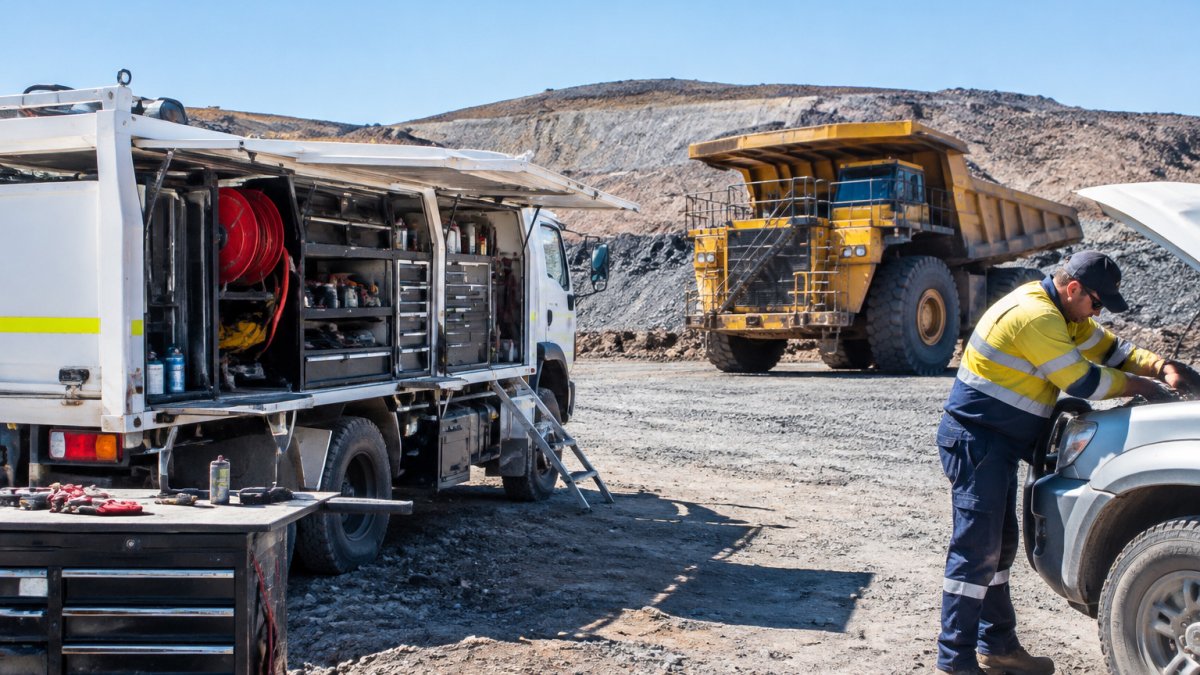
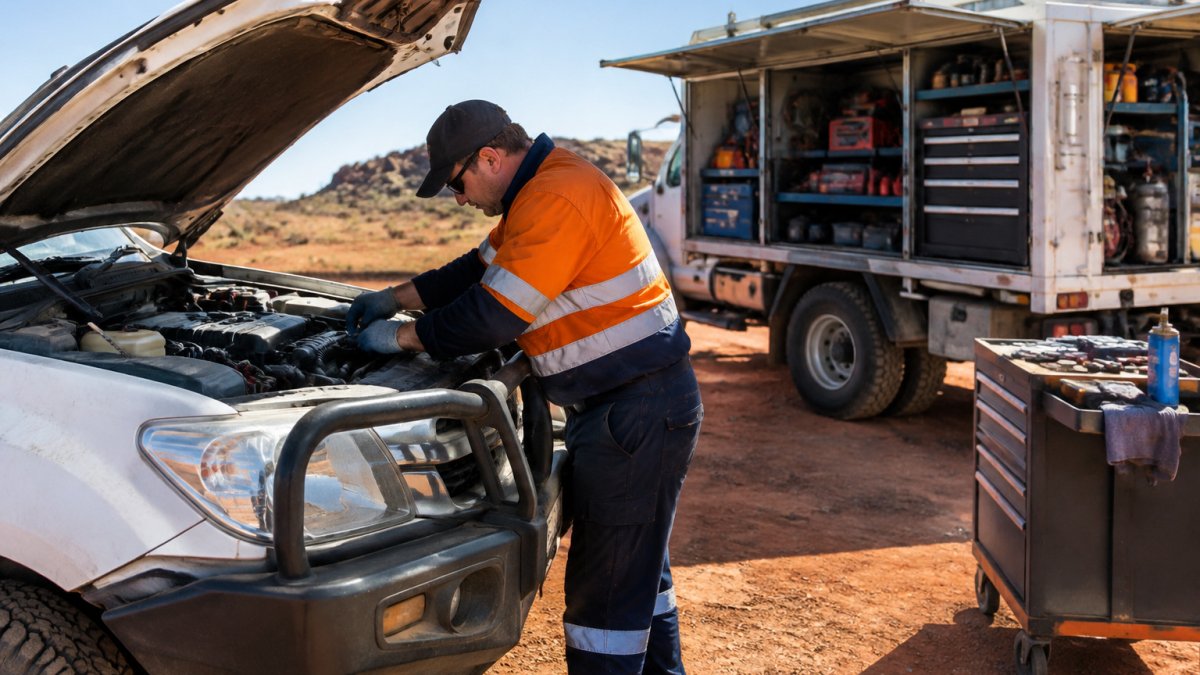
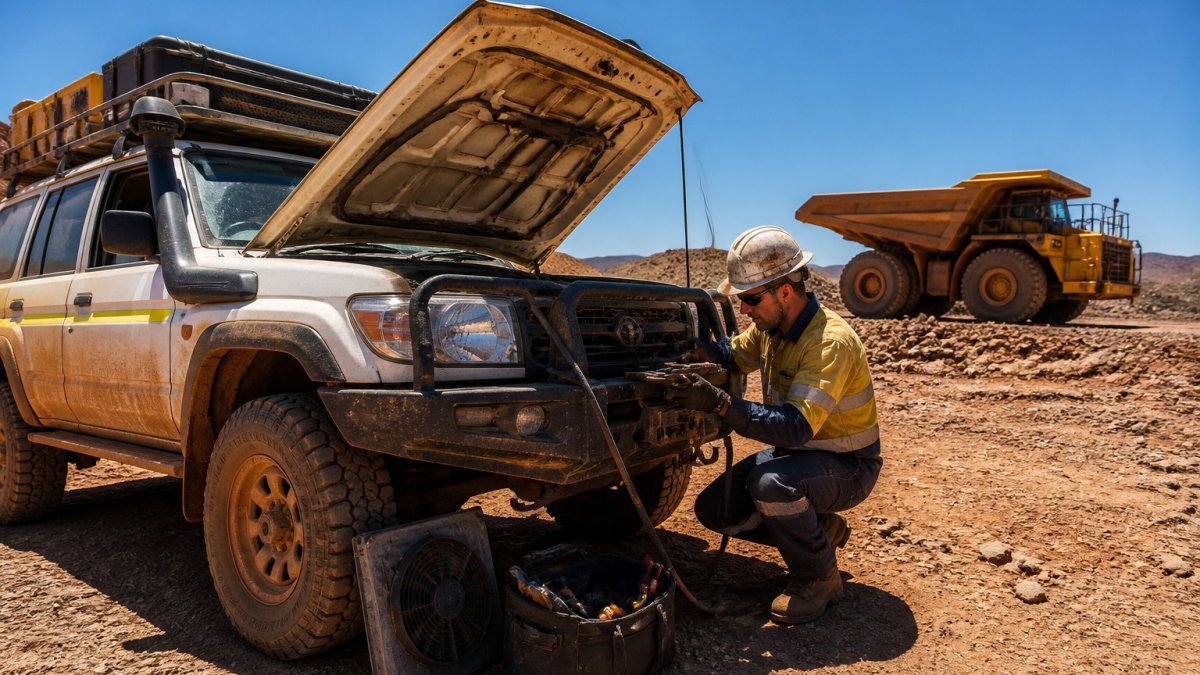
A mobile technician can inspect faults, re-gas the system, replace filters and check pressures on site. That turnaround matters most in peak summer, when every hour of lost cooling affects crew welfare.
Where a fault needs parts or a larger workshop, plan for it early. Keep common filters and fittings on hand where the fleet size justifies it.
Booking Your Fleet's Next Air Conditioning Inspection
Book an inspection before the hottest months, while there is still time to plan around shifts. A full inspection covers the checklist, the pressure and temperature checks, and a written record for each vehicle.
If you manage a fleet across several sites in the region, ask whether your provider can respond to breakdowns at each location and how that is scheduled during peak season.
Frequently Asked Questions
How often should mining vehicle air conditioning be serviced?
Most fleets benefit from a full inspection before the hot season starts and then a routine service at regular intervals, with condenser cleaning and filter changes done more often in dusty conditions. The exact interval depends on the vehicle's hours, the site's dust load and the manufacturer's recommendations. Logging each service against the vehicle's hour meter makes it easier to spot patterns and plan maintenance without pulling vehicles off shift at short notice.
What are the signs that a mining vehicle's air conditioning needs repair?
Warning signs include vent air that is warmer than usual on a hot day, a cabin that takes much longer to cool down, unusual noise from the compressor or fan, a clutch that cycles on and off frequently, and visible oil staining around fittings. Any of these can point to low refrigerant, a restricted condenser or a failing component. Reporting symptoms early usually means a smaller repair and less time out of service.
Why does dust affect air conditioning systems in mining vehicles?
Dust builds up on the condenser and evaporator, which reduces airflow and heat transfer, so the system works harder and cools less. Clogged filters also restrict airflow into the cabin and can strain the blower motor. Regular cleaning of the condenser and timely filter replacement are the most practical ways to keep cooling capacity up in dusty mine environments.
Can mobile air conditioning maintenance reduce mining fleet downtime?
It can, because a technician who comes to the vehicle avoids the time lost driving to a workshop and waiting for a bay. Mobile service is most useful for routine inspections, condenser cleaning, refrigerant checks and minor repairs. Pricing depends on the scope of work, the number of vehicles and the site location, so contact T U Mechanical Contracting through its website for a quote tailored to your fleet.